
Understand how search indexes, AI crawlers, company ownership and data partnerships can shape the sources behind generative results, and what this means for GEO, AEO and AIO.
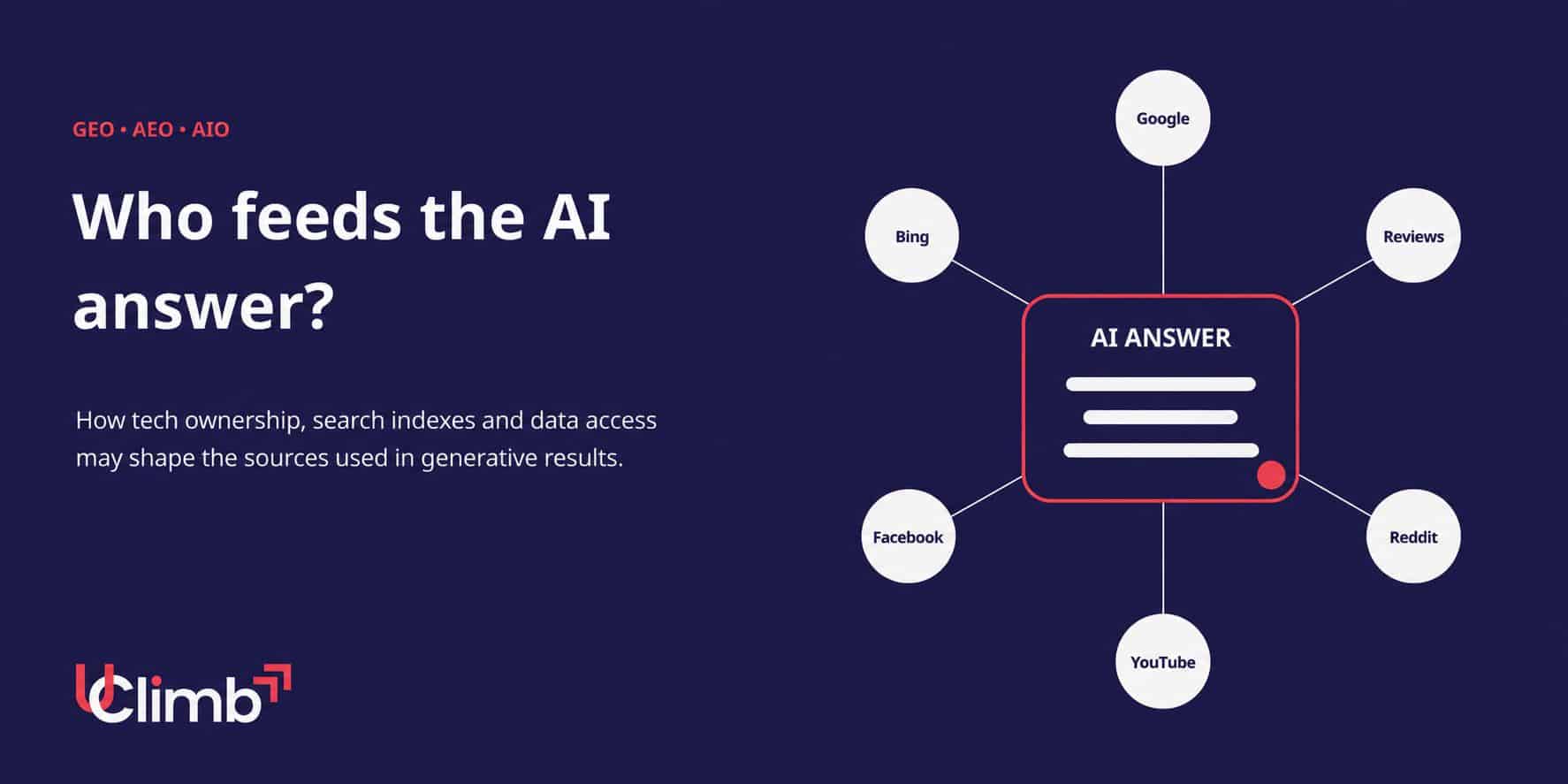
Tools such as ChatGPT, Google AI Overviews, Microsoft Copilot, Perplexity and Meta AI do not all retrieve, interpret and present information in the same way. Some draw heavily on an established search engine, while others combine search results with their own crawlers, content partnerships, licensed datasets and information supplied directly by publishers.
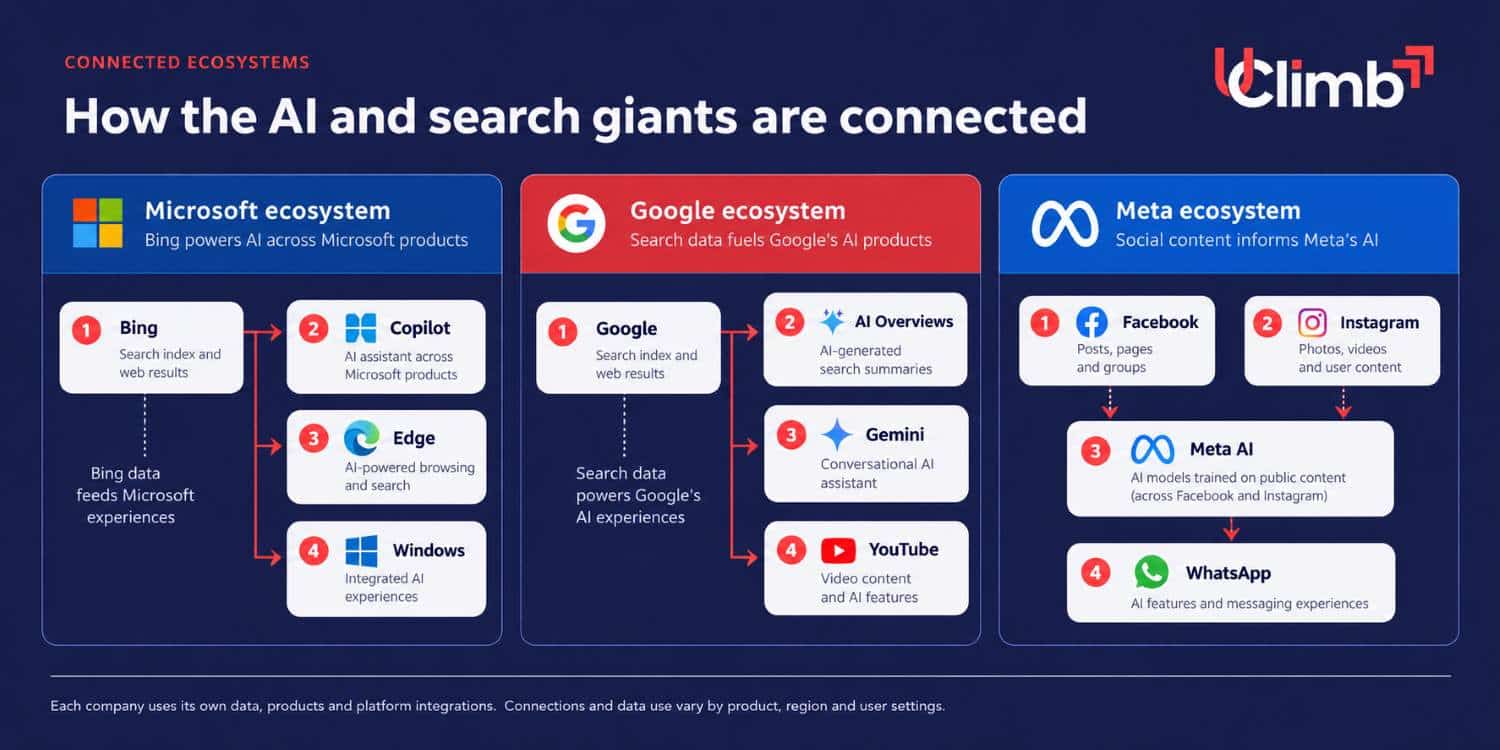
The relationships between the companies behind these tools can also influence which information is most readily available to them. Microsoft owns Bing and has invested heavily in OpenAI. Google owns YouTube and has a commercial data partnership with Reddit. OpenAI also has a Reddit agreement, while Anthropic distributes Claude through both Amazon and Google’s cloud platforms.
These connections do not prove that one platform will always favour a particular website or publisher. The selection systems used by generative AI products are largely private, frequently updated and considerably more complicated than a list of preferred domains.
However, the publicly known relationships can still help marketers make better decisions. When considered alongside traditional SEO, digital PR, reputation management and content strategy, they provide useful clues about how a brand may become visible across AI-generated search results.
Why Data Sources Matter for GEO, AEO and AIO
GEO, AEO and AIO are often used to describe closely related forms of optimisation.
Generative engine optimisation, or GEO, usually refers to improving visibility within answers produced by generative AI platforms. Answer engine optimisation, or AEO, tends to focus on helping search engines and digital assistants provide clear answers to users’ questions. Artificial intelligence optimisation, or AIO, is commonly used as a broader term covering visibility across AI-led search and discovery experiences.
The terminology is still developing, and different agencies may use the labels in slightly different ways. In practice, they share a central objective: helping search and AI systems understand a business well enough to mention, recommend or cite it accurately.
To achieve this, marketers need to consider more than the content published on the company website. Strong SEO content remains important, but AI systems may also draw on numerous independent and third-party sources.
An AI-generated answer may be informed by:
- Search engine results
- Website content retrieved by an AI crawler
- Review platforms
- News and trade publications
- Social media discussions
- Business directories
- Forums such as Reddit
- Videos and transcripts
- Product feeds and structured data
- Licensed datasets
- Information supplied through commercial content partnerships
The mix is likely to vary according to the platform, the subject and the wording of the user’s question.
A request for a legal definition may rely heavily on authoritative government sources. A product comparison may draw on reviews, retailers, publishers, YouTube videos and forum discussions. A local recommendation could involve business listings, customer reviews, location data and editorial round-ups.
Understanding the information ecosystem therefore gives marketers a better chance of appearing within it.
The Difference Between Ownership, Investment and Data Access
Much of the confusion surrounding AI platforms comes from treating several different commercial relationships as though they were the same.
There are four broad types of connection to consider.
Ownership
Ownership creates the clearest relationship between two products.
Google owns YouTube, for example, while Microsoft owns Bing and Copilot. Meta owns Facebook, Instagram and WhatsApp.
Companies naturally have deep technical access to the platforms they own, although this does not automatically mean that content from an owned platform receives preferential treatment in every search result.
Investment and Commercial Partnerships
An investor may provide funding, infrastructure or access to technology without owning the company receiving the investment.
Microsoft has invested heavily in OpenAI and provides substantial Azure cloud infrastructure. OpenAI remains a separate company, however, and ChatGPT should not be described as a Microsoft-owned product.
The relationship is commercially important, although it does not show that every ChatGPT answer is drawn directly from Bing.
Search and Retrieval Access
An AI assistant may use a search provider to obtain current information from the web.
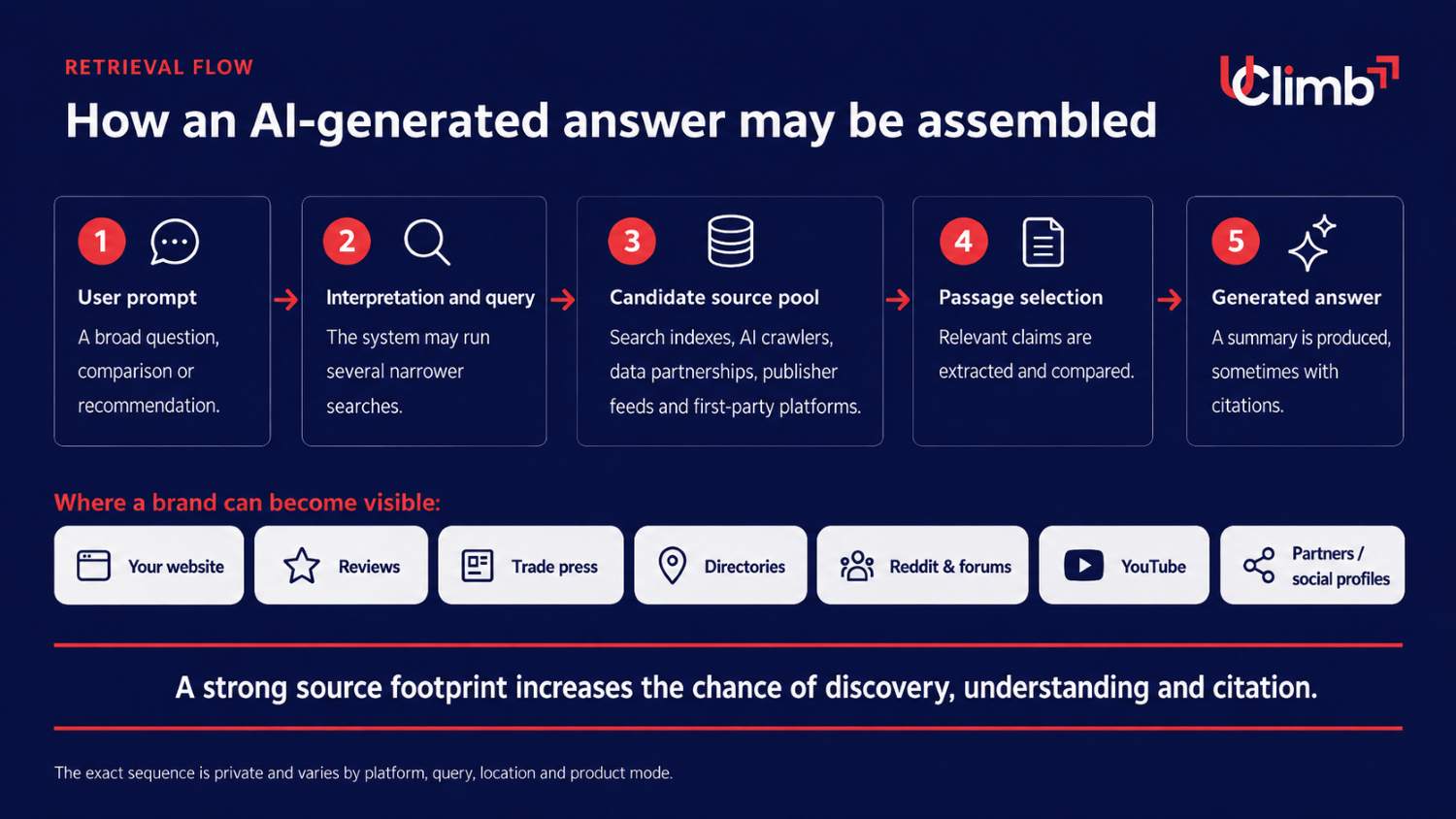
This type of relationship is particularly important because language models do not always answer from their training data alone. When live search is available, the system may rewrite the user’s prompt into several queries, retrieve pages and then use those pages to construct a response.
The search provider may influence which pages enter the candidate pool, but the AI platform can still apply its own methods when choosing which information to quote, summarise or cite.
Licensed Data and Content Agreements
Technology companies may enter agreements that give them structured or real-time access to content from another platform.
Google and OpenAI both have publicly disclosed agreements involving Reddit’s Data API. These relationships may help their systems understand current conversations on Reddit more efficiently than they could through ordinary web crawling alone.
This does not necessarily amount to a fixed ranking advantage for Reddit. It does mean that Reddit content may be easier to access, classify and refresh within certain AI systems.
Platform comparison
Where each AI search experience appears to look first
| Platform | Strongest known relationship | Other known routes | Practical priority |
|---|---|---|---|
| Google AI Overviews | Google Search index and ranking systems | Query fan-out, YouTube, data partnerships | Good SEO, original content, entity authority |
| Microsoft Copilot | Bing search and grounding ecosystem | Microsoft-owned data and services | Bing indexation and Bing Webmaster Tools |
| ChatGPT Search | Bing is a confirmed search provider | OAI-SearchBot, publishers, partners and other providers | Bing visibility, crawler access and wider authority |
| Perplexity | Perplexity crawler and search index | External sources and different answer models | Direct crawl access and citation-worthy pages |
| Meta AI | Meta's first-party platform ecosystem | Public web information where available | Accurate profiles, useful public content and entity consistency |
This reflects public information and cautious inference. Platforms can use additional sources, and their retrieval systems may change.
Microsoft, Bing, OpenAI and ChatGPT
One of the most common assumptions in AI optimisation is that Microsoft owns ChatGPT.
Microsoft owns Bing and Copilot, and it has made major investments in OpenAI. It also supplies cloud infrastructure through Azure and has rights to use OpenAI technology within its own products.
OpenAI nevertheless remains a separate company.
This distinction matters because it would be too simplistic to assume that ChatGPT reproduces Bing rankings in the same order.
OpenAI has publicly identified Bing as one of the search providers used within ChatGPT Search. It has also referred to other third-party providers, direct publisher relationships and its own search crawler.
A likely process is that ChatGPT interprets the user’s question, produces one or more related search queries, retrieves information and then generates an answer using the sources it considers relevant. The exact process is private and may vary according to the query.
This creates an important relationship between Bing visibility and ChatGPT visibility, although it falls short of a direct one-to-one connection.
A page that performs well in Bing may have a better chance of being retrieved for a related ChatGPT query. The page would still need to be accessible, relevant to the rewritten search and suitable for use within the final answer.
Studies examining the overlap between Bing results and ChatGPT citations have produced widely varying findings. This may be partly explained by differences in methodology, search mode, subject area and timing. AI products are also changing quickly, which makes definitive conclusions difficult.
For marketers, the sensible interpretation is that Bing optimisation may support ChatGPT visibility, while broader web authority remains important.
Microsoft Copilot Has a More Direct Relationship With Bing
The connection between Bing and Microsoft Copilot is considerably clearer.
Both are Microsoft products, and Microsoft has openly discussed the role of Bing’s search ecosystem in grounding Copilot answers. Bing’s own webmaster guidance also refers to visibility across search and AI-led experiences.
A business seeking exposure within Microsoft Copilot should therefore pay close attention to:
- Bing indexation
- Bing Webmaster Tools
- Crawl accessibility
- Accurate titles and page descriptions
- Structured data
- Clear entity information
- Microsoft business listings
- Consistent product and service information
A technical SEO audit can help identify indexation, canonicalisation, crawler access and site-structure problems that may restrict visibility across conventional and AI-led search.
Bing should not be treated as an afterthought when planning AI visibility.
Google Search, AI Overviews and AI Mode
Google’s AI Overviews and AI Mode appear to have a more direct relationship with traditional Google search visibility.
These features operate within Google Search and make use of Google’s index, ranking systems and quality signals. Google has also described a process often referred to as query fan-out, where a broad user question can generate several narrower searches behind the scenes.
This helps explain why a source cited in an AI Overview may not rank prominently for the exact phrase entered by the user. It could rank for a related question, supporting concept, comparison or subtopic that Google searched during the process.
A page generally needs to be indexed and eligible to appear in Google Search before it can become a supporting source for an AI Overview. Strong conventional SEO therefore appears to remain closely connected to AI visibility within Google.
This includes:
- Crawlability and indexation
- Helpful and original content
- Relevant internal linking
- Clear page purpose
- Strong topical coverage
- Accurate structured data
- Reliable authorship and business information
- External authority and reputation
While no-one outside Google knows the exact weighting of each factor, AI Overview optimisation should begin with sound Google SEO rather than a separate collection of technical tricks. Our on-page SEO checklist covers many of the foundations that help search systems understand and evaluate individual pages.
Google, Reddit and the Value of First-Hand Discussion
Google has a commercial agreement giving it access to Reddit’s Data API. OpenAI has a similar relationship with Reddit.
These agreements are important because Reddit contains a large volume of current, highly specific and experience-led discussion. Users regularly share product feedback, service experiences, recommendations, objections, comparisons and troubleshooting advice.
For many conversational questions, this is precisely the type of information an AI system may find useful.
Examples include:
- Which product works best in a particular situation?
- What are the drawbacks of a service?
- Is a company reliable?
- What do customers wish they had known before buying?
- Which supplier is best for a specialist requirement?
- How does one product compare with another in daily use?
Reddit may therefore have a structural advantage for certain types of query. Its content is current, detailed and often expressed in natural language that closely resembles the questions people ask AI assistants.
The data partnerships may make that content more readily accessible, although they do not prove that Reddit receives an automatic boost in every generative result.
Businesses should also approach Reddit carefully. Creating artificial conversations, planting promotional comments or attempting to disguise marketing activity as independent customer opinion can damage trust and may breach platform rules.
A more sustainable approach involves:
- Monitoring relevant discussions
- Answering questions transparently where appropriate
- Learning from common customer concerns
- Improving website content based on those concerns
- Encouraging genuine customer advocacy
- Building products and services that people choose to discuss positively
Customer discussions should be supported by genuine reputation-building activity across established platforms. Our guide explains how to generate authentic Google reviews and why detailed customer feedback matters for search visibility and trust.
Reddit visibility is usually most valuable when it reflects real experience rather than a manufactured campaign.
Google and YouTube
Google owns YouTube, giving it direct access to one of the largest collections of video content in the world.
YouTube videos frequently appear within standard Google search results, and video content may also support AI-led search experiences where a visual explanation is useful.
The platform is particularly relevant for:
- Product demonstrations
- Tutorials
- Software walkthroughs
- Reviews and comparisons
- Repairs and maintenance
- Before-and-after examples
- Expert interviews
- Technical explanations
- Case studies
Video transcripts also give search and AI systems substantial text to interpret.
It would be difficult to prove that Google favours YouTube simply because of ownership. YouTube’s prominence can also be explained by its size, established search integration, user engagement and suitability for visually led questions.
Even so, the relationship makes YouTube difficult to ignore within a broad GEO or AIO strategy.
A strong video can create several forms of visibility at once. It may rank in Google, appear in YouTube search, be quoted or summarised through its transcript, attract links, support brand recognition and become a source for an AI-generated explanation.
Google, Facebook and Instagram
Google does not own Facebook or Instagram. Both are owned by Meta.
Publicly accessible Facebook Pages and eligible Instagram content can still appear in Google’s index. Social profiles may help corroborate a company’s name, location, products, services and current activity.
However, this relationship is different from Google’s agreement with Reddit. There is less public evidence of a comparable structured data arrangement between Google and Meta for Facebook or Instagram content.
This means that public social content may contribute to visibility where it is indexable, relevant and accessible, while claims of a direct Google preference for Facebook or Instagram would be difficult to support.
Social platforms can still play an important role in entity building. A company whose website, social profiles, directories, reviews and media coverage all describe the same services in consistent language may be easier for search and AI systems to understand. Accurate business information should also be maintained through an appropriately optimised Google Business Profile.
Meta AI and Meta’s First-Party Ecosystem
Meta AI operates across Facebook, Instagram, Messenger and WhatsApp.
This gives Meta access to an extensive first-party ecosystem involving public content, creators, businesses, social interactions and areas of user interest. Meta AI can also use information from the wider web, depending on the product and query.
The implications for optimisation are still developing.
A strong Meta presence may help a business become more recognisable within Meta’s environment, especially where people actively discuss, follow, share or engage with the brand. However, organic reach, private conversations, advertising systems and AI-generated answers are separate areas, so marketers should avoid assuming that success in one guarantees visibility in another.
Useful activity may include:
- Maintaining complete and accurate profiles
- Publishing original visual content
- Answering customer questions
- Encouraging genuine discussion and sharing
- Keeping product and service information current
- Using consistent brand and location details
- Developing recognised subject experts within the business
Perplexity and Its Own Retrieval System
Perplexity is often described as an AI answer engine because source citation is central to its interface.
The platform operates its own crawlers and search infrastructure, although it may use different language models when generating responses. This distinction is important.
The model that writes an answer and the retrieval system that finds the evidence do not have to come from the same company.
For website owners, direct crawl accessibility is therefore particularly relevant. A page that is blocked from Perplexity’s crawler may be less likely to appear as a current source, regardless of how well it performs elsewhere.
Marketers should check whether important content can be accessed by recognised AI search crawlers while continuing to make considered decisions about privacy, copyright and model training. Crawler access should form part of a wider technical SEO review, rather than being treated as an isolated AI optimisation task.
Anthropic, Claude, Amazon and Google Cloud
Anthropic has commercial relationships with both Amazon and Google, and Claude is available through Amazon Bedrock and Google Cloud Vertex AI.
These are significant investment, infrastructure and distribution relationships. They do not provide clear evidence that Claude prefers websites owned by Amazon or sources ranking in Google.
This illustrates the danger of drawing SEO conclusions from investment announcements alone.
Cloud hosting determines where a model runs. Distribution agreements determine where customers can access it. Neither necessarily reveals how the system retrieves sources for a particular answer.
The same caution should be applied across the AI industry. A company may invest in a model provider, host its infrastructure, license its technology or distribute its products without controlling every source-selection decision.
Why AI Source Selection Is Difficult to Predict
Generative search results are more variable than conventional rankings.
A traditional search engine usually presents a list of pages in a visible order. An AI platform may instead:
- Interpret the user’s wording
- Rewrite the question into several searches
- Retrieve sources from different systems
- Extract relevant passages
- Compare or combine the information
- Generate a new answer
- Select a smaller number of citations
A change at any stage can alter the final result.
Two users may receive different answers because of location, personalisation, search mode, recent events, query wording or product updates. The same query may also produce different citations when repeated.
This makes it risky to promise a fixed method for achieving an AI mention.
A more credible goal is to improve the likelihood that a brand will be discovered, understood and trusted across several information environments.
What This Means for Your GEO, AEO and AIO Strategy
The ownership and data relationships between technology companies offer useful context, although they should be interpreted carefully.
Bing visibility would seem likely to support discoverability within Microsoft Copilot and may improve the chance of retrieval within ChatGPT Search. Google visibility appears closely connected to AI Overviews and AI Mode. Reddit’s agreements with both Google and OpenAI may make its discussions particularly accessible for certain questions. YouTube remains highly relevant within Google’s wider search ecosystem, while first-party platforms may play a growing role within Meta AI.
None of these relationships provides a guaranteed route into a generative answer.
AI platforms can use several sources, rewrite prompts into related searches and apply their own relevance and quality systems before producing a response. Their exact methods are private and likely to keep changing.
The most dependable approach is to make the brand visible, consistent and credible wherever customers and machines may encounter it.
That means combining technical SEO with useful content, entity building, reviews, community participation, video and independent authority. Relevant backlinks, media coverage and expert contributions can help corroborate the claims made on the company’s own website.
Companies that develop a strong presence throughout this wider ecosystem may be better placed to earn visibility as search becomes increasingly generative.
For a practical implementation framework, follow our step-by-step approach to holistic GEO, AEO and AIO.
Author
-
 View all posts
Founder of UClimb Ltd
In the dynamic world of digital marketing, Daniel Noakes stands out as a beacon of innovation and integrity. As the founder of UClimb Ltd in 2019, Daniel has carved a niche in the SEO industry, driven by a mission to provide results-focused services. His journey into the realm of SEO was catalysed by firsthand experiences with the darker aspects of the field, including black hat SEO tactics and agencies that failed to deliver true value. These challenges, faced in his previous business endeavours, ignited a passion in Daniel to redefine the SEO landscape.
Daniel's foray into in-house SEO was not just a choice but a necessity, leading him to uncover and refine the unique methodology that now forms the backbone of UClimb's core services. Under his guidance, UClimb has evolved from a mere SEO service provider into a holistic digital marketing agency. His visionary approach ensures that website creation and design are not just aesthetic pursuits but are intrinsically woven with SEO principles from the ground up.
Daniel's LinkedIn Profile: https://uk.linkedin.com/in/danielnoakes1
As a leader, Daniel is committed to transparency and efficacy, qualities that are the cornerstone of UClimb Ltd. His expertise and dedication are not just about leading a successful agency; they are about elevating the standards of the SEO industry and delivering unparalleled value to clients.
