The Project
A long-standing Australian supplier was preparing for a major digital restructure. The business had acquired Where About Supply, a company selling a similar range of products, with the acquisition driven in part by the strength of the whereaboutsupply.com.au domain, its existing rankings and organic traffic.
The plan was to retire the existing WS Supplies websites, simplify the combined product range and launch a completely rebuilt website on:
whereaboutsupply.com.au
Several existing domains also needed to be permanently redirected:
- wssupplies.com.au
- wssupply.com.au
- wsupplies.au
- wsupplies.com.au
Two other domains, wssupplies.com and wsupplies.com, were to be retained separately and offered for sale.
On paper, this was already a substantial SEO migration. The deadline made it considerably more challenging.
The Challenge
We were contacted in early December with an absolute deadline of 31 December.
The project involved several teams, with the client based in Australia and our SEO team in the UK. The time difference meant that without careful coordination, a question asked during the UK working day could easily create a significant delay before receiving an answer.
At the same time, this was far more complicated than simply moving one website onto another domain.
The client wanted to significantly reduce and simplify the product ranges found across both the existing WS Supplies website and the recently acquired Where About Supply website. A completely new website was already being developed on a temporary domain, using a different platform and a revised product structure.
That meant thousands of old URLs could not simply be redirected to identical versions on the new website.
Our objective was to preserve as much existing organic search value as possible despite the products, URLs, website structure and domain all changing at once.
Building the Migration Plan
Before the deadline approached, we gathered access to everything we were likely to need, including Cloudflare and DNS management, website administration, Google Search Console and GA4.
We also confirmed that the domains involved in the migration were being managed through Cloudflare so that the final redirects could be implemented centrally.
From there, we began building a complete picture of what Google and users actually valued across the existing websites.
Search Console was used to identify the pages generating the most organic clicks on both sites, whether or not an equivalent page appeared to exist on the new website. GA4 data provided another view of the pages attracting meaningful user traffic.
We then created a master migration spreadsheet containing:
- URLs from the existing WS Supplies website
- URLs from the acquired Where About Supply website
- URLs available on the new website being built on its temporary domain
This became the foundation of the redirect strategy.
Using AI Without Handing Over the Decision-Making
With a large number of URLs and a very compressed timeframe, manually comparing every page from scratch would have been inefficient.
We therefore used AI as an initial matching tool.
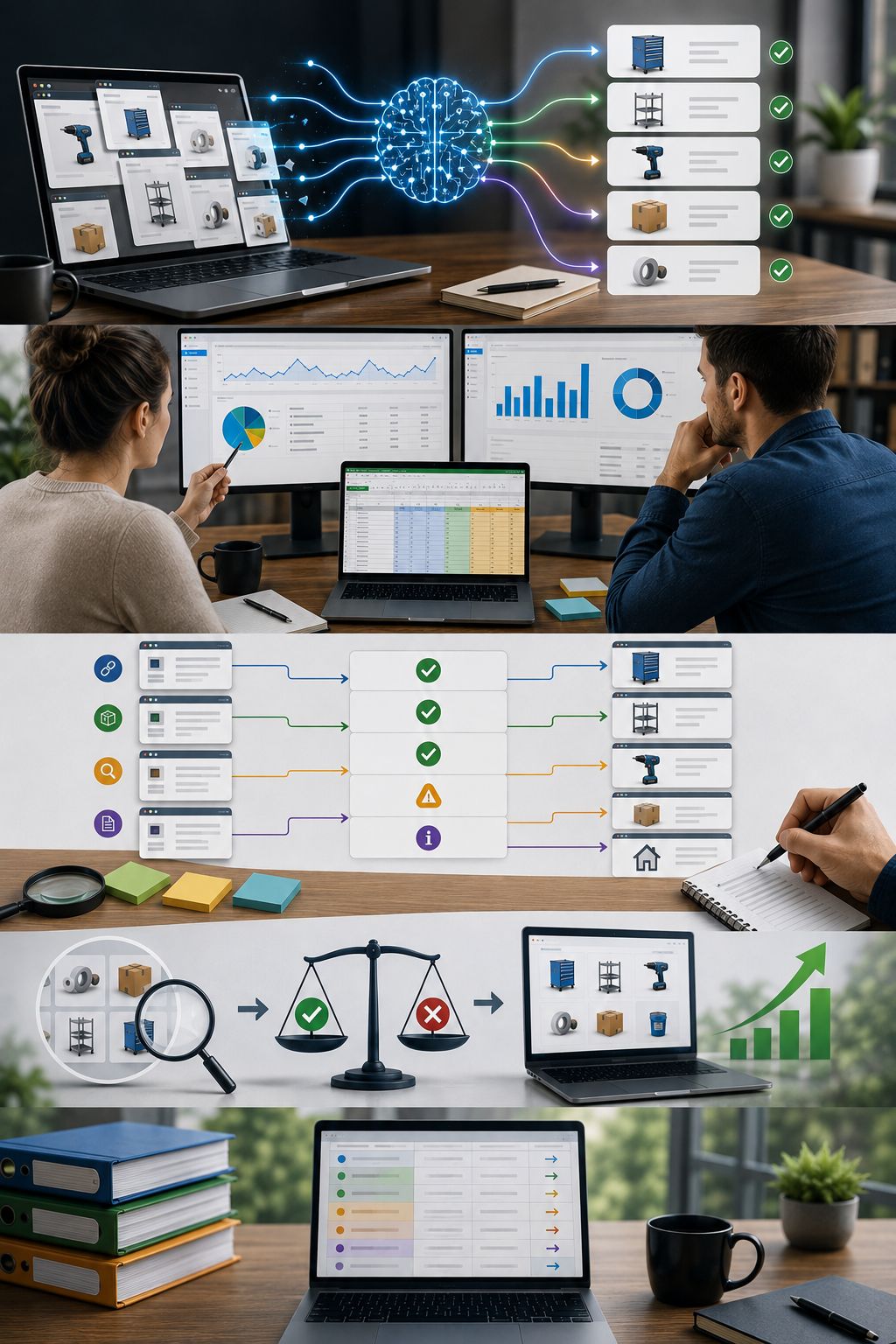
Detailed prompts were developed to compare URL structures, product names, shared terminology and other patterns across the three sets of URLs. The output gave us a first-pass recommended redirect destination for large groups of pages.
However, we deliberately did not treat those recommendations as final.
Approximately 20 hours of specialist SEO time across two team members went into reviewing and refining the redirect map. One team member, known for an exceptional eye for detail and the patience required for lengthy QA work, handled much of the granular comparison. A senior SEO manager carried out further reviews, spot checks and judgement calls.
Initially, we repeatedly tested the AI recommendations and adjusted the prompts until the bulk matching became reliable. The final stages involved several hours of manual checking, including opening pages across all three websites and comparing the actual products rather than relying solely on their URLs.
That human review became particularly important where there was no perfect equivalent.
The 1,000 White Napkin Problem
One example illustrates the level of detail involved.
An old product page selling 1,000 white, 30cm, 1-ply napkins had generated valuable organic traffic, but that exact product would no longer exist.
The new website contained several alternatives, including:
- 500 x 25cm 2-ply napkins
- 250 x 30cm 1-ply napkins
- Other white napkin variations
There were also several additional discontinued napkin URLs to account for.
A redirect tool can identify matching words such as “white”, “napkin”, “30cm” and “1-ply”. It cannot reliably decide which characteristics matter most to somebody landing from Google.
We manually assessed cases like this to determine the closest useful destination, balancing product type, specification and likely search intent.
That process was repeated across the catalogue wherever the new range no longer provided a simple one-to-one replacement.
Protecting Historical SEO Value
Current website crawls were not enough.
Some URLs that had previously generated substantial Google traffic had already disappeared from the websites by the time the migration project began.
To avoid losing the authority and traffic associated with those URLs, we went back through Search Console data and identified historical performers.
Every URL that had generated more than 100 organic clicks during the previous three months was added to the redirect plan, even when the page itself no longer existed on the live website.
Where a strong equivalent product or category existed, the URL was redirected to the closest relevant destination.
Where there genuinely was no suitable equivalent, discontinued product pages were redirected to the homepage. Blog and informational URLs without a suitable replacement were directed to the main blog archive rather than being left unresolved.
It was not always perfect from a search relevance perspective, because the new product range simply did not contain equivalents for everything being retired. The priority was to make the strongest possible decision from the destinations actually available.
Managing a High-Pressure International Project
With the deadline approaching, communication became as important as the technical SEO work.
We created a dedicated WhatsApp group containing a director and marketing manager from the client, relevant members of their wider project team and three members of the UClimb team.
This allowed questions about discontinued products, redirect destinations, technical implementation and approvals to be handled much more quickly than conventional email communication would have allowed.
It also led to some unusual working hours.
There were multiple late-evening conversations in the UK that coincided with the start of the working day in Australia, helping to reduce the delays that could otherwise arise from the time difference.
Despite this, delays around final approval of redirects and clarification of discontinued products eventually pushed the migration extremely close to the deadline.
The 11pm Message
As 31 December approached, some of the redirect work submitted for approval had still not received final sign-off.
We asked the client to make a decision: should the migration proceed despite some outstanding approvals, or should the hosting for the old website be extended into January to provide more time?
With key contacts away over the holiday period, no final instruction came back.
Then, at approximately 11pm UK time on 2 January, UClimb’s founder noticed a message in the project WhatsApp group.
The old website was now offline. The client wanted to know why the redirects had not gone live.
The situation was explained and, because it was already morning in Australia, the client immediately confirmed that the redirect deployment should proceed.
There was one complication.
The members of the team who would normally handle that element of the Cloudflare configuration were already in bed and unavailable.
Rather than leave the client’s former website offline and its organic traffic landing on dead URLs until the following morning, UClimb’s founder took responsibility for completing the deployment.
He had never previously imported a redirect migration of this type directly through Cloudflare.
Between midnight and 1am, he researched the required Cloudflare configuration, checked how the redirect spreadsheet needed to be structured and carefully imported the rules.
Multiple live tests were then carried out across different URL types to confirm that the redirects were resolving to the intended destinations.
Once satisfied that the migration was functioning correctly, the client was notified in Australia.
The site migration was live.

Post-Launch Checks
The work did not end when the DNS and redirect rules were activated.
Post-launch checks were carried out to confirm that redirects were behaving correctly and that the new website was receiving traffic as expected. We also reviewed GA4 and conversion tracking to ensure that the change of domain and platform had not left the business without visibility of important user activity after launch.
Approximately 20 hours of specialist SEO time across two team members went into reviewing and refining the redirect map. One team member, known for an exceptional eye for detail and the patience required for lengthy QA work, handled much of the granular comparison. A senior SEO manager carried out further reviews, spot checks and judgement calls.
Initially, we repeatedly tested the AI recommendations and adjusted the prompts until the bulk matching became reliable. The final stages involved several hours of manual checking, including opening pages across all three websites and comparing the actual products rather than relying solely on their URLs.
That human review became particularly important where there was no perfect equivalent.
The Outcome
This was an unusually demanding migration because almost every variable changed simultaneously:
- The primary domain changed
- The website platform changed
- The site structure changed
- Two established websites were being consolidated
- Large parts of the product range were discontinued
- Many old pages had no direct equivalent
- Multiple additional domains required redirection
- The client and SEO teams were working across a significant international time difference
- The project had to be completed around the Christmas and New Year period
- The original site ultimately went offline before final deployment had taken place
A combination of Search Console and GA4 data, AI-assisted URL analysis, detailed manual review and rapid communication allowed us to build a redirect strategy that prioritised the pages with genuine organic search value.
More importantly, we did not allow automation to make the difficult decisions for us. Whether assessing a major category page or deciding where somebody searching for 1,000 white 30cm napkins should land after their original product disappeared, each important redirect was considered in the context of what would be most useful to both users and search engines.
And when an unexpected 11pm message meant the final deployment could no longer wait until the next working day, we found a way to get it live.
Author
-
View all postsFounder of UClimb Ltd
In the dynamic world of digital marketing, Daniel Noakes stands out as a beacon of innovation and integrity. As the founder of UClimb Ltd in 2019, Daniel has carved a niche in the SEO industry, driven by a mission to provide results-focused services. His journey into the realm of SEO was catalysed by firsthand experiences with the darker aspects of the field, including black hat SEO tactics and agencies that failed to deliver true value. These challenges, faced in his previous business endeavours, ignited a passion in Daniel to redefine the SEO landscape.
Daniel's foray into in-house SEO was not just a choice but a necessity, leading him to uncover and refine the unique methodology that now forms the backbone of UClimb's core services. Under his guidance, UClimb has evolved from a mere SEO service provider into a holistic digital marketing agency. His visionary approach ensures that website creation and design are not just aesthetic pursuits but are intrinsically woven with SEO principles from the ground up.
Daniel's LinkedIn Profile: https://uk.linkedin.com/in/danielnoakes1
As a leader, Daniel is committed to transparency and efficacy, qualities that are the cornerstone of UClimb Ltd. His expertise and dedication are not just about leading a successful agency; they are about elevating the standards of the SEO industry and delivering unparalleled value to clients.